Emotions are a concept that likely existed before the written or spoken word. Language, however, is now the main way of communicating and as such it has become the way we think. To think is to create means that how you use words, and the amount of words available to us, directly impact how you define our possibilities.
- Bioenergetic Origins
- Expanding Vocabulary to Expand Possibilities
- Etymology
- Power of Words
- Symbolism and Glyphs
- Korean Language
- Gender Grammar

Bioenergetic Language Origins
This article, kickstarted by researching Kundalini energy, covers some language basics. These language basics will help us understand bioenergetic concepts recorded in ancient scripture. You can take a moment to go beyond assuming you know the meaning of “mantra” or “kundalini.” When you look at these words a bit closer you gain a next-level understanding that a mantra is a tool for protection and that kundalini is a spiral of energy with a feminine essence.
Studying bioenergetics to heal or expand spirituality is an experience that involves self-experience and research. This research involves receiving information, by listening, reading, or writing, and means the main tool of communicating then becomes ancient words and alphabets.
In learning bioenergetics as a tool for healing a lot of concepts have their start in ancient knowledge and mysticism. As such they originate from ancient script languages of Sanskrit and Hebrew.
Sanskrit is an ancient Indian language and Hebrew is a Afro-Asianic language of the Semitic family. Both of these are script languages which means they have their own form of writing.
Generations use words in many different ways. With this type of usage words quickly lose their actual meaning or quickly obtain a new one. Gay, Spinster, and Cunt are all examples of words that had a different meanings 100 years ago.
Taking the time to assess the words provides insights into the original idea and sentiment.
Expand Vocabulary to Expand Possibilities
This is important for exploring new healing modalities. It is also why the “Starting Therapy” section has been focused on emotional vocabulary. If you can not think of the different levels and ways of being happy, you can not conceptualize them. Language is a part of the creative process, and the creative process is a part of the healing process.
One of the easiest tools to start building is emotional vocabulary. It is the easiest tool to implement and expand your possibilities.
Compared with this quick method, etymology also offers other methods of examining words.
Etymology and Language

The word etymology originates from the Greek word meaning “true.” This tool etymology breaks down the true meaning of words.
Etymology is the best tool for studying the meaning of words. One of the quickest ways to use etymology is to break words down into their root words and assess their meaning. In this way you can use etymology as a quick process of analyzing words and how their meanings have changed through time. See how this approach was used in understanding the power of Mantras and the energy of Kundalini.
At a time when the concepts of mantras and chakra resonance started to develop, language as a tool also began to develop. This was in the spoken word, which focused on repetition and meaning. But as we begin to examine the etymology of words, a new level of understanding of language develops. At this new level of understanding a new concept can be born.
Power of Language and Symbolism

Sign language is a perfect example of words and symbolism. Sign language shows how powerful hand symbols can be to visually communicate knowledge and provide meaning. In alphabets with script and glyphs symbols are used instead of letters. Looking up the symbol of a word is a second way to understand additional meaning.
The structure visually communicates a sound, a resonance, and some times complex thoughts. The frequency relation in Hebrew letters and words is an example. The slight difference in calligraphy and pronunciation in Chinese characters is another. A more recently uncovered meaning of hieroglyphic symbols of the Mayan, which employs a lot of artistry and sculpture as their characters.
This can also be true for languages with letter alphabets, think the dove and peace. A dove being pure and white a representation of being comfortable with the truth. A bird that can take flight and rise above situations on the ground. In this way the symbol of peace take on more meaning than a pleasant calmness.
Lets take a closer look at script and symbol languages.
Symbolism and Glyphs
The picture below from unraveling mag is an example of how artistic a glyph language can be. It is also a good example of symbolism that can still convey a meaning centuries later. Even without knowing Mayan, you can look at the glyph and get a sense of a fierce cat.

Korean Language
The Korean language has a beautiful origin story and how intention with direct action can bring knowledge to people.
In preparing for a work trip I studied the Korean Language. I found myself distracted by how the Korean Characters looked. I have always liked how pleasant and fun all the symbols looked in comparison to other Asian characters. Other Asian characters carry a sense of seriousness to them with their sharp, quick lines, whereas Korean has some softness and roundness to them.
My research back then led to the story of the Korean Monarchy. The King did not think his eldest son was fit to be king. So he looked to his second oldest, who wound up abdicating the thrown. This brought in the third son, who has taken on a lifestyle that is more like that of a monk.
He did take to the thrown and created the Korean language.
The new king did not think that reading and writing should be reserved for the elite and aristocrats but should be accessible to all people.
This was an unpopular position at the time, so the new king worked with monks underground to design a language that would be easy to learn. This help from monks caused a bit of controversy, but regardless, a new language was born under the new king’s rule and leadership. The king undoubtedly had a role to play in its formation.
It was also said that he wanted the characters of the words to represent the meaning of the word and sound. Which I found particularly interesting as I was visually impressed by the characters already.
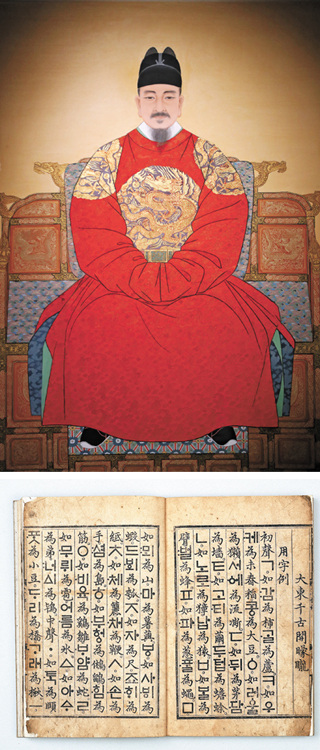
This was the birth of modern Korean, which is very visually different from the Chinese characters used previously.
Gender Grammar
While exploring the kundalini of the body another language tool of gendered language comes into play. Looking into the historical contexts of gender and roles can provide additional meanings to words.
English is a natural gender language with masculine and feminine grammar structures explaining the biological gender of things with pronouns and sometimes nouns.
However, gendered languages, have masculine and feminine forms for nouns. A noun is a person, place, or thing. In English, a book is a book; there is no gender coordination dependent on its owner, recipient, or reader. In the case of gendered languages, nouns have gender properties where the gender grammar changes if there is a male in the group. If you have studied Spanish, this is the difference between “el” and “la,” which is inserted in front of nouns.
For context, here is a glimpse at gender grammar across different world languages.
Romance Languages
In Hindi, Spanish, French, Italian, Arabic, Hebrew, and Portuguese nouns are classified as masculine or feminine.
Germanic Languages:
Sanskrit, German, Icelandic, Russian, and polish nouns are classified as masculine, feminine, or neutral. For example, “der Hund” (the dog – masculine) and “die Katze” (the cat – feminine).
It was interesting to learn that in Swahili, nouns are classified into various noun classes that include gender distinctions and that many Non-Gendered Languages, such as Finnish, Turkish, and Hungarian, do not use grammatical gender.
Grammatical gender systems vary widely in complexity and application across different languages, reflecting diverse cultural and linguistic histories.
Using etymology you can gain a new level of understanding. This provides new perspectives, concepts, and tools to use for healing.
Resources
You can follow our emotional vocab series for a while longer on Pinterest, Instagram, TikTok, and Facebook.