
Summary
Neuroscience often equates speed of response with depth of understanding. This article clarifies why timing data describes initiation, not lived experience, and why confusing the two creates gaps between science, mind, and meaning.
Theme: milliseconds vs seconds vs lived experience
Core ideas:
- Unconscious initiation (ms) vs subconscious access (seconds) vs conscious narration
- Why fast ≠ meaningful
- Why response timing is not experience
- The layered cascade model (initiation → embodiment → cognition)

Sections
- Summary
- Orientation
- Framing Neuroception and Neuroscience Definitions
- What Neuroscience can Measure
- Subconscious Processing
- Reframing A Mind-based Framework
- Conclusion
- Practices that Honor Understanding
- Wisdom to Go
Orientation
This measurement does not happen solely in the brain, but across the nervous system as a whole.
Exploring Polyvagal Theory (PVT), developed by Dr. Stephen W. Porges, required understanding how neuroscience defines subconscious, unconscious, and conscious processing. What followed was a deeper inquiry into the structure and language of neuroscience itself. From a spiritual perspective, this bridge is not obvious, and across this article series, we will untangle why science, spirituality, and socio-political environments often struggle to coexist.
This is not a deep dive into Polyvagal Theory. That framework simply brought us here.
This is an exploration of what is required to apply neuroscience meaningfully, without mistaking measurement for total reality.
This is also not biohacking.
If you are looking for shortcuts or optimization strategies, you are in the wrong place. There is no need to hack what is inherently yours. Sustainable regulation emerges from understanding, not from forcing, overriding, or exploiting biological systems.
Hack – to break into; a person misrepresenting who they are or what they can provide
Bio – life
Hacking is not the foundation of sustainable authentic being.
Framing: Neuroception and Neuroscience Definitions
Because my work focuses on the mind as a whole, consciousness at large, and individual conscious, subconscious, and unconscious areas of the mind, this definition initially felt imprecise. My engineering mind finds discomfort in incomplete solutions, so the deeper question:
What does neuroscience actually mean when it uses the terms conscious, subconscious (preconscious), and unconscious?
Neuroscience defines these categories as follows:
Conscious
Awareness, meaning-making, symbolic interpretation, language.
Subconscious / Preconscious
No current awareness, but content can be recalled or verbalized. Involves cortical and limbic processing. Slower than reflexive circuits.
Unconscious
No access to language or imagery, no symbolic content, reflexive processing only. Occurs in milliseconds.

What Neuroscience Can Measure
Neuroscience supports the unconscious category through timing data:
- Autonomic shifts (heart rate, pupil dilation) occur within 50–150 milliseconds
- Conscious awareness begins to emerge around 300–500 milliseconds
- Language formation and narrative explanation take longer still
This means the body responds before language exists to describe the response. The brain is still organizing meaning while the nervous system has already shifted state.
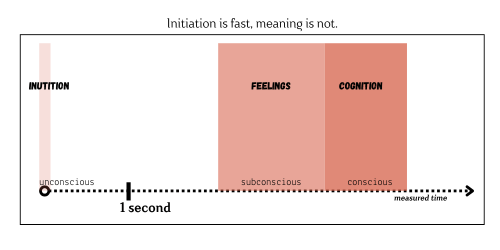
(Diagram: timing cascade → initiation → embodiment → cognition)
The autonomic nervous system, responsible for breathing, blood flow, and survival regulation, operates as the body’s autopilot. These processes are associated with structures such as:
- Brainstem nuclei
- Periaqueductal gray (PAG)
- Hypothalamus
- Reticular activating system (RAS)
These regions are assumed to generate no thought, no memory, and no symbolic representation.
You respond to your environment before you understand or verbalize why.
Supporting Evidence for Unconscious Processing
Unconscious processing is supported through observations involving:
- Cortical damage
Individuals with cortical injury still demonstrate startle responses, vagal shifts, and freeze reactions. - Anesthesia
Threat responses persist even when conscious awareness is suspended. - Infants
Nervous systems respond before language or symbolic cognition exists.
In neuroscience terms, neuroception is defined as detection without awareness, interpretation, or cognition. It occurs too quickly for thought and without cortical involvement.
Subconscious Processing
Subconscious processes:
- Can be recalled
- Can be verbalized
- Can be influenced by thought and imagery
They are associated with:
- Amygdala–hippocampal loops
- Insula
- Medial prefrontal cortex
Neuroscience describes where and when processing occurs in the body by measuring neural and autonomic activity.
What it does not measure is the mind itself, or the organizing intelligence behind experience.
The piece missing is the mind and the bridge to get there.
Reframing: A Mind-Based Framework
In a mind-based model:
- Consciousness
Awareness, agency, problem-solving, and integration of lived experience. - Subconsciousness
Embodied, emotional, memory-linked felt experience. This layer gives rise to symbolic meaning, for example, why a rose signifies love. - Unconsciousness
Suppressed or unintegrated experiential memory. Operates through archetypal tones and symbolic emergence, not narrative recall.
All three layers are expressions of you. How information is processed depends on history, memory, and internal organization.
Neuroscience-based systems explain how and where information is processed.
Mind-based systems explain how experience is organized, stored, and accessed.
This distinction is incomplete; neuroscience appears to equate unconscious processing with “not mind.” In practice, what it actually means is:
Non-symbolic, non-narrative, non-representational processing at the point of initiation.

Conclusion
The brain and the mind overlap, but they are not identical. Understanding their intersection requires linguistic precision and epistemic humility.
Neither framework is wrong. Each observes experience from a different dimension.
The next article explores why modern neuroscience relies on “non-” language, and how defining reality by negation shapes what we believe exists and what we dismiss.
Practices that Honor Understanding
Sovereign Rayne works with the mind as living intelligence, engaging practices that honor natural structures, cycles, and deeper knowing. These practices draw from ancient lineages while integrating what neuroscience reveals, always prioritizing trauma-sensitive healing. Explore workshops and my private teaching platform at Lumyst. Start with the free modules for workshops to get a feel for the processes or dive into foundational offerings.
Wherever you start, I’ll meet you there. Your next step is waiting.
If this perspective resonates, start with the free Lumyst module.
Learn the right tool for the job.
Then become proficient at it.
The tools inside Sovereign Rayne aren’t new.
They’ve been taught for years in psychology, philosophy, and spiritual traditions, often in workshops that cost far more than this course.
What’s different here is the structure.
I’ve organized them into a repeatable system that bridges science and mysticism without spiritual bypassing.
No glorification of suffering.
No vague advice.
Just tools you can actually use.
One thing I know is that you took longer reading this article than it will take you to learn efficient tools that can change your life.
I didn’t invent these tools.
I engineered a system for using them.
Wisdom to Go
Download and save the quote cards below.
Set them as wallpapers for daily orientation.
For questions or feedback: [email protected]