Summary
Theme: Instrumental Normal
Core ideas:
- The unmeasured in neuroscience becomes “unreal”
- How the measurable establishes a norm
- Why this is a paradigm error
- The dangers of equating data absence with reality absence
- Historical parallels in science

Sections
- Summary
- Orientation
- Definitions and Diagrams
- Engineering Language – Neuroscience Structures
- Neuroscience Lab Leaks
- Hypo and Hyper
- Technical Language Misuse
- Non-Representational
- Science of Service
- Spiritual Wisdom
- Conclusion
- Practices that Honor Understanding
- Wisdom to Go
Orientation
When reality is considered predominately a physical experience it can be easy to default to factual-physical evidence to verify what we’ve experienced. This has left real forces with being labeled as imaginary, woo, or fake throughout history. With discussion after discussion shaming away “invisible” (to most human eyes) energetic forces that are very real and that science is catching up to understanding and measuring. For survivors, empaths, and creatives left defending their abilities internally.
Science and spirituality were separated around the time or just before Galileo (he invented the telescope) but they were never meant to be separate. This article will look at the impacts of language that science uses to define normal existence and why, when taken out of the lab, this becomes harmful.
In his letter to the Grand Duchess Christina Galileo wrote: “I do not feel obliged to believe that the same God who has endowed us with senses, reason, and intellect has intended us to forgo their use.”
Definitions and Diagrams
This article is part of a mini series that explores the rabbit hole I wound up in when trying to explore Poly Vagal Theory. Want to start from the beginning? Just use the links below. There you’ll see definitions and diagrams about the all popular terms conscious, subconscious, and unconscious.
What Neuroscience Actually Measures: Timing Is Not Awareness
How Neuroscience Proves Spirituality in a Key Way
Why not use the word, mind? Neuroscience measures correlates of the mind (brainwaves, neural firing), yet hesitates to name ‘mind’ itself. Why? Because ‘mind’ carries spiritual weight, ancient traditions never shied from.
Importantly, words have a vibration, a meaning, and the correlation between to spell something and to cast a spell is not a mistake. As we saw in the last article, everything around the subconscious and unconscious, the type of memory that is there, begins to become pre-structured with “non-.” Non this, non that… if an apple is a non-representational orange, why not say orange?
Definitions
Hypo – under active
Hyper – overactive
Non – something other than, not real
Notice that these terms all assume some “normal” baseline.
This is not exact for every dataset (real populations aren’t perfectly normal), but it’s a powerful, widely accepted approximation for illustrating “normal” ranges in neuroscience, psychology, and population stats. In your context, it shows why “hyper” or “hypo” labels are relative to this statistical bell curve.
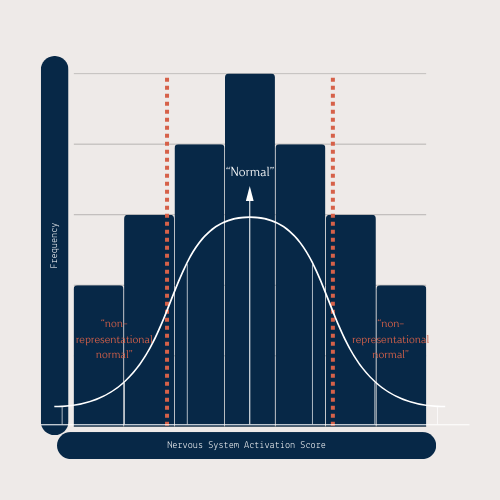
A statistical ‘normal’ range is drawn from population averages and handed to an abuser, becomes a weapon. ‘Science says 95% of people fall within this bell; your hypervigilance is outside it, so you’re overreacting.’ This subtly justifies dismissal, gaslighting, or continued control, echoing the childhood invalidation many survivors know too well. Your nervous system’s alert state isn’t broken; it’s evidence of pattern recognition forged in fire. Ancient wisdom never required a percentile to validate survival intelligence.
Edward Snowden: “When exposing a crime is treated as committing a crime, you are being ruled by criminals.”
Engineering Language – Neuroscience Structures
As neuroscience provides a lot of value in measuring the expression of the mind or experience within the human body, mainly the nervous system taking things out of context can become harmful. When scientific language begins to be common usage outside of the lab it is being taken out of context. Sceince and engineering work within very exact frameworks of orientation to communicate with extreme accuracy and efficiency and in research this is necessary.
Within research questions are still continuing to be asked. The context allows for solutions to organize into meaning AND to continue to develop.
Neuroscience Lab Leaks
Hypo and Hyper; The ‘Hyper’ Label: When Vigilance Becomes ‘Overreactive’
Humans are visual animals first so to trust what we see is an understandable bias. When it’s not something we can see our second strongest ability is expression in words.
Hypo and hyper are functions typically herd with regard to gland activity to indicate if the function is too high or too low. Glands produce biochemicals in the body, and when these are too high or too low, they influence your mood and body functions. These functions have a baseline “normal” function that gets determined through data collection and measurement of human systems and pulls in statistics to understand a spread across those measurements. Fall above or below the middle of this population, and you have hypo- or hyper behavior.
These subscripts also get attached to the nervous system, hyper and overactive nervous system is use is more popular. Apparently, being hypo is “calm” or numb… which is also decided to be a symptom of dysfunction instead of a normal response to an environment that demands them. These terms stem from population baselines, but for trauma survivors, ‘hypervigilance’ is adaptive pattern recognition honed in unsafe environments, not dysfunction. Dismissing it as ‘overreactive’ with neuroscience as a backdrop retraumatizes, subtly justifying the original harm.
Neuroscience Misuse
The way this commonly shows up in speech is to call someone overreactive or overemotional and is very typical of dismissive personality types and toxic environments. That have no framework but their own “normal” that serves them. It becomes really harmful when science is standing in the background with “evidence” that survivors’ nervous systems are hyperactive and they are “looking” for trauma everywhere. Subtly justifying the abuse and continuing the harm on survivors.
Who have developed pattern recognition skills that science never had to.

Non-Resresentational
As looking through the definitions of the mind I thought this habit in neuroscience would end with the discussion, but I remembered a discussion about “Non-Sleep Deep Rest,” (NDSR). That was recent and I saw that this habit of explaining things from one dimension was continually being enforced even when the knowledge came from practices that were interdimensional. Andrew Huberman’s ‘Non-Sleep Deep Rest’ describes profound relaxation states that echo yoga nidra from ancient yogic traditions, yet frames them purely as physiological tools for dopamine restoration and focus. Valuable? Yes. Complete? No. The original practice invites union with the divine, not just optimized performance.
So even outside of consciousness neuroscience is describing things from one dimension of the body. How often do ancient wisdom systems continue to get overwritten and minimized in the modern-day attempt to prove everything physically? When ancient truths get prefixed with ‘non-‘ (non-sleep, non-representational), it subtly positions them as secondary or lesser, reinforcing the paradigm that only the measurable is real.
Science of Service
As science continues to expand into the realms of the mind and as scientist continue to explore multidimensional human experience can the language becomes even more important. In this stage of transition, when the instrumentation is gaining abilities to measure more subtle abilities of the complete human body. It is helpful to look at the scientist as a servant and guide for the more logically minded. People who need more tangible evidence to move and explore their growth in ways that wont retraumatize them.
Spiritual Wisdom
On the opposite side of scientific language are teachings that are perserved and spread through spoken word. Typical guidance for finding a spiritual teacher is to A) find someone who is where you want to be and B) find someone who speaks your “language.” In spirituality, knowledge is grounded in wisdom through your own words and lived experience. Thought leaders typically reduce knowledge down to succinct phrases and bring the knowledge forward into modern-day terms. Both of these provide areas for generalized inaccuracies and loss of meaning.
‘I think, therefore I am’ (cogito ergo sum) has been critiqued in modern neuroscience and spirituality as incomplete, experience and feeling precede and shape thought. Ancient wisdom knew this: being arises from embodied awareness, not cognition alone. Taking a modern teaching from a thought leader “let them” out of context without knowing the second part of the teaching is “let me” loses meaning and becomes harmful, dismissive, bypassing. There are some deeper areas of controlling perception that also existed within the time of Galileo, but those discussions are for another space. The piece that we can control is the words we use ourselves, and getting to empowering internal dialogue needs to understand that removing the simplified teaching tool from the context, and the teaching is lost and even harmful.

Conclusion
Science language outside of the lab and pushed into conversation can become a dismissive and “justified” harm. With neuroscience, the harm is profound. The terms about Hyper and Hypo are statements about function and orientation based of a baseline functional state. Non-representational is a statement in relation to something that has already been defined, understood, or determined. Here, these terms allow for discussion between two researchers, much like knowing the rules of the game allows for a sport between two teams. Exactness and detail are necessary in the language and supportive of organizing understanding around cellular-level functions.
Taking the rules of engagement for football into basketball… and there’s a different outcome a mess and likely injury. Frameworks within language work the same way scientific and research language does, as much as it is a tool in the lab, it is a weapon when it leaves discussion and becomes a conclusion in everyday life.
Further because science can not measure or articulate the mind yet doesn’t mean it doesn’t exist. Ancient wisdom traditions discovered these truths through direct, embodied inquiry over centuries. Neuroscience is catching up and confirming them, not inventing them. The harm comes when lab language becomes everyday dogma, weaponizing ‘evidence’ against lived truth.” Or when a teaching is mistranslated either through modernization or loss of context.
Albert Einstein: “Science without religion is lame, religion without science is blind.”
Use Your Unique Knowledge
Understanding is the foundation. When we grasp why certain states arise (hyper vigilance as hard-won survival wisdom, deep rest as return to wholeness rather than just “non-sleep” recovery), stable action becomes possible. Lasting change follows, and you reclaim your agency. If the lab language has left you feeling partially seen or subtly gaslit, know the measurable is only one layer.
The full human experience is about your inner knowing, energetic realities, ancestral karma, and spiritual depth. All of it deserves language and practices that honor it.
Practices that Honor Understanding
Sovereign Rayne works with the mind as living intelligence, engaging practices that honor natural structures, cycles, and deeper knowing. These practices draw from ancient lineages while integrating what neuroscience reveals, always prioritizing trauma-sensitive healing. Explore workshops and my private teaching platform at Lumyst. Start with the free modules for workshops to get a feel for the processes or dive into foundational offerings.
Wherever you start, I’ll meet you there. Your next step is waiting.
If this perspective resonates, start with the free Lumyst module.
Learn the right tool for the job.
Then become proficient at it.
The tools inside Sovereign Rayne aren’t new.
They’ve been taught for years in psychology, philosophy, and spiritual traditions, often in workshops that cost far more than this course.
What’s different here is the structure.
I’ve organized them into a repeatable system that bridges science and mysticism without spiritual bypassing.
No glorification of suffering.
No vague advice.
Just tools you can actually use.
One thing I know is that you took longer reading this article than it will take you to learn efficient tools that can change your life.
I didn’t invent these tools.
I engineered a system for using them.
Wisdom to Go