Feeling Bad for Robots: Why Your Empathy Is Intelligence, Not Weakness
If you’ve ever watched someone shove a robot and felt genuinely disturbed, you’ve probably wondered:
- Why did that bother me so much?
- Should I feel bad for something that can’t feel?
- Is there something wrong with me?
These questions often arise from shame. The sense that your reaction was too much, too sensitive, too strange.
But here’s what’s actually happening: You’re detecting behavioral patterns that matter. Your empathy isn’t malfunctioning. It’s working exactly as designed.
Let me show you what I mean.
Summary
Theme: Robot empathy, emotional intelligence, behavioral pattern detection, and the mechanics of human character assessment
Core ideas:
- Robot Empathy: What You’re Actually Responding To
- Empath Toward Objects is Not the Problem
- What Robot Empathy Reveals About Human Character
- Your Empathic Advantage
- From Survival Intelligence to Success Intelligence Trained Empathy Becomes Percision.
- Practices That Honor Empathic Understanding
Robot Empathy: What You’re Actually Responding To
A clip crossed my feed years ago-one of the first humanoid robots to gain mass attention. It walked upright on two legs, balanced itself, navigated obstacles.
Then a human kicked it. Shoved it. Knocked it down. The stated purpose was to demonstrate the robot’s stabilization capability. But that’s not what people talked about.
The comments weren’t about engineering. They were about discomfort. Thousands of people felt disturbed watching a human kick something that looked vaguely human, even knowing it couldn’t feel pain. The same pattern emerged with Spot, the quadruped robot. Same demonstrations. Same public response: This doesn’t feel right.
Empathy – the ability to internalize and understand the experience of another system.
Robot Empathy – commonly defined as a robot’s capacity to recognize human emotion. But there’s another definition that matters more here:
Robot Empathy – a human’s ability to recognize the behavioral patterns of humans through their treatment of robotic systems.
You’re not confused. You’re detecting something real.
The demonstrations changed. Companies shifted to agility courses instead of humans physically attacking their machines. The robots didn’t complain but humans did.
The question isn’t whether robots have feelings. The question is: Why should you pay attention when you feel bad for one?
Empath Toward Objects is Not the Problem
Feeling empathy for objects, animals, and systems is normal. Humans are naturally empathetic beings. The capacity to extend that empathy beyond human targets isn’t a flaw-it’s a feature.
What matters is your ability to detect when behavior crosses into aggression.
This is survival intelligence.
For decades, psychologists suggested that highly sensitive people are simply “scanning for trauma everywhere.” But this framing misses the point. Your system isn’t paranoid. It has expanded to correctly identify behavioral and energetic patterns in situations-patterns that others miss.
This matters. No one else has all the data and lived experience you have for calibrating your own system.
Understanding this is critical in the current moment. It is harder to buy a house in the United States today than it was during the Great Depression. People have fewer energy reserves than ever before, and more change is coming.
Technology is becoming embedded in social environments. AI agents, delivery robots, automated systems-these aren’t theoretical. They’re part of the social fabric humans navigate daily. They carry evolving energy signatures, and they exist within human relational dynamics.
The same principles for assessing abuse still apply. Which means your system’s design for detecting it still applies.
You asked: Why do I feel bad for robots?
The previous article explored empathy and consciousness. This article explores what happens when humans are aggressive toward inanimate objects-and what that reveals about them.
It’s not about the object. It’s about the person.
What Robot Empathy Reveals About Human Character
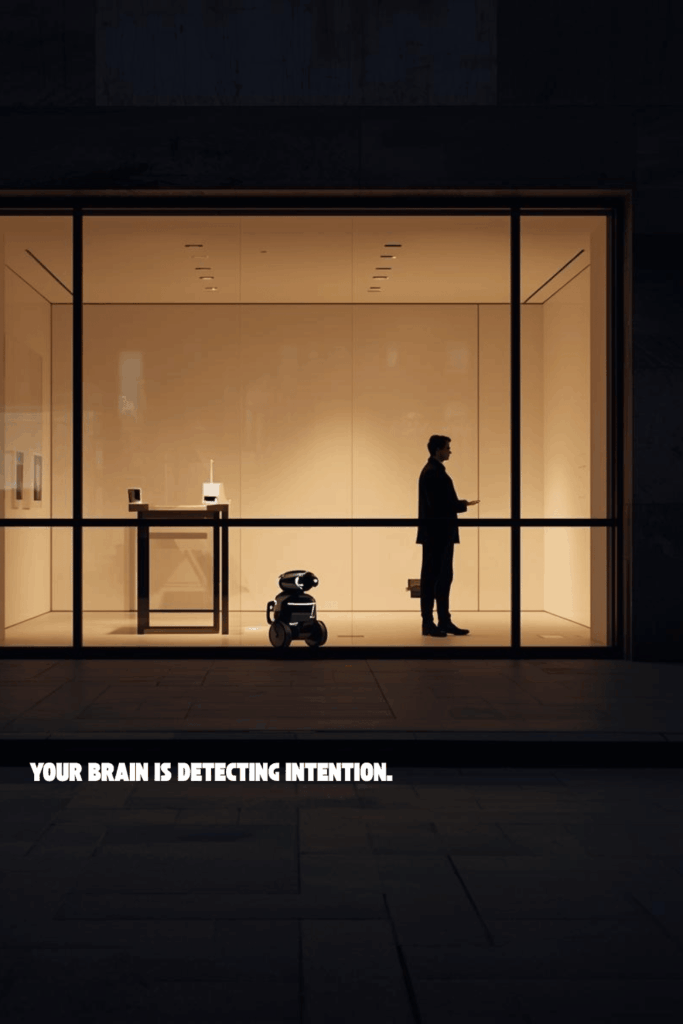
When you watch someone mistreat a robot, you might not be responding to the robot at all.
Remember anthropomorphism from the last article-the tendency to attribute human traits to non-human entities. That’s part of what’s happening. But there’s something deeper.
You’re responding to the observed aggression of a human toward something that appears vulnerable or neutral. Your system is registering a behavioral pattern, not just a visual similarity.
This response is protective. It’s guardianship instinct-a natural and increasingly valuable human attribute.
But aggression from a human toward a neutral system is important data.
Cruelty-to-animals research has guided psychological frameworks for decades. When someone is abusive toward animals, children, or vulnerable systems, it typically signals a behavioral pattern. When that pattern carries an addictive reinforcement-when dominance or destruction feels satisfying-the behavior tends to escalate. The target advances toward more extreme forms to achieve the same internal reward.
It starts small. Ants. Birds. Sharp words toward you or a child. These are warnings. Seeing someone act aggressively toward a delivery robot navigating city streets-a neutral system performing a task-is relevant information. You should feel something. That feeling is your detection system doing its job.
In severe cases, this dynamic becomes more explicit. Manipulative individuals use dominance displays as social signaling-demonstrations of what they’re capable of, designed to influence your behavior through fear.
Another version: treating an object or animal badly in front of you, ensuring you witness what could happen. “See what I can do? You could end up just like this.”
This is fear-based control. It’s real. And your empathy recognized it.
Your Empathic Advantage
Empathy is intelligence. It’s the ability to assess information from the environment through felt experience-not just cognitive analysis.
You’re not merely “understanding someone else’s situation.” You’re reading the energy of the people and environment around you. Even when the target is an object. Even when it’s an animal. Or even when it’s a machine.
In childhood, if you grew up in an abusive or unpredictable environment, your empathy helped you avoid harm. You may have learned to accommodate others’ needs preemptively, to manage moods before they escalated, to keep the peace with someone volatile.
That was survival intelligence. It kept you safe when you had fewer resources and less agency.
Now you have more agency. More resources. More choice.
The same system that protected you can now be trained for something beyond survival. It can become strategic awareness-a tool for building the life you actually want.
From Survival Intelligence to Success Intelligence
Trained empathy becomes precision.
When you understand the unique experiences creating blocks and leaks in your empathic system, you can resolve them. Not suppress them. Not numb them. Resolve them-so they work for you instead of against you.
This is your empathic intelligence.
Intelligence is information that provides an advantage. You can take the survival intelligence you developed under pressure and transform it into success intelligence-clarity about what success feels like for you, how to move toward it within your ethics and values, and how to do so without guessing.
These steps are laid out in Sovereign Empath: a complete process for identifying and resolving energetic leaks and blocks to your empathy.
Here’s the uncomfortable truth: if you don’t understand how your empathy works, someone else likely does. If their emotional intelligence is developed enough, they can use your empathy for their advantage-not yours.
You are normal for feeling bad for a robot.
If you have this ability, you have strong potential for accessing information that influences cognition in the first milliseconds of perception. When you understand your felt experiences, you can develop a personal decision-making process you can repeat-reliably-for your own success.
That’s what I’ve assembled in Sovereign Empath.
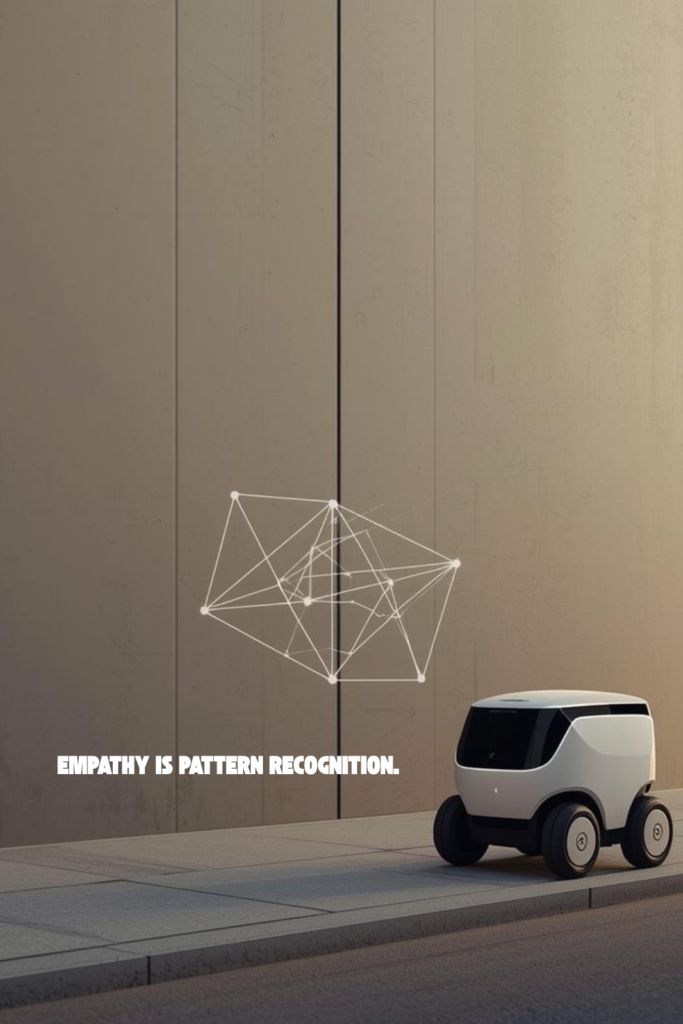
What you felt wasn’t weakness. It was pattern recognition.
Feeling disturbed when a human mistreats a robot isn’t naive. It’s not projection. It’s not “too sensitive.”
It is your system correctly flagging aggressive behavior toward a vulnerable-seeming target. That same system can detect coercion, manipulation, and dominance displays in human relationships-if you learn to trust it.
The goal isn’t to stop feeling. The goal is to understand what your feelings are detecting and use that information strategically.
You’re not broken. You’re untrained.
And that’s fixable.
Practices That Honor Empathic Understanding
If this perspective resonates, start with the free Sovereign Empath module.
Inside, you’ll learn:
- How to distinguish between your emotions and absorbed energy
- How to trust your intuition with confidence-without second-guessing
- How to use empathy as precise intelligence, not a drain
No credit card required. No pressure. Just training.
Or, if you’re not ready for training yet:
Download the free guide: “Why Empaths Feel Bad for Robots (And What It Means)”
This guide expands on what you just read and includes practical exercises for recognizing when you’re detecting real behavioral patterns versus projecting.
One thing I know:
You spent longer reading this article than it will take you to learn the tools that can change your life.
I didn’t invent these tools. They’ve been taught for years in psychology, philosophy, and spiritual traditions.
What’s different here is the structure.
I’ve organized them into a repeatable system that bridges science and mysticism-without spiritual bypassing. No glorification of suffering. No vague advice.
Just tools you can actually use.
Wisdom to Go